
Wingard said Onslaught shares The Guest's universe. Moriarty is the trilogy town.
At Comic-Con he called it a cap on You're Next and The Guest. Same New Mexico pin. Same black-budget programs. Dan Stevens wears a new face. The town stays cursed.
Today is Wednesday, September 2, 2026, and Adam Wingard already answered the Comic-Con question the trailer was asking. Onslaught, A24's September 4 action-horror, takes place in the same town and the same universe as The Guest. Not a vibe. Not a fan wiki hopium thread. Wingard's own words, recorded by the Associated Press at San Diego Comic-Con and amplified by Dread Central, Bloody Disgusting, and Empire: it is not a direct sequel that continues those characters, but it takes place in the same town as The Guest, the secret programs are other aspects of the same thing David came from, and you could technically call it a sequel because it is in the same universe. I am Bart Christoff, and the Theories desk is not inventing Easter eggs. The director handed us the map. Moriarty is the trilogy town.
Start with the geography, because Wingard did. The Guest, 2014, put Dan Stevens' David Collins into a grieving family's house around Halloween and let a military medical experiment wear a polite smile until the smile became a massacre. Onslaught puts Adria Arjona's Celeste into a desert trailer park outside the same Moriarty, New Mexico, and lets a squad of genetically engineered super soldiers escape a facility up the road. AV Club's review reminded readers Moriarty is real, a tiny city in the greater Albuquerque area with a Pinto Bean Fiesta on the municipal calendar. Wingard did not invent a fake New Mexico. He reused a real pin on the map and told AP the main throughline is the city. That is franchise architecture wearing a municipal website.
Wingard did not tease a cameo. He named the town. Moriarty is the trilogy SKU.
The trilogy claim is the second half of the theory, and it is also on tape. Wingard told the Comic-Con press scrum he looks at Onslaught as a cap on the trilogy between The Guest and You're Next. Empire's SDCC report has Stevens himself calling it a spiritual sequel that lives in the same universe, then clarifying he is not playing David again. He is playing a German mad-scientist type, Dr. Hans Kammler in the cast lists, with Rebecca Hall as a dominatrix-coded handler wife in the same program that unleashes the soldiers. Wikipedia's Onslaught page now states that after previously being called a spiritual sequel, Wingard confirmed the film sits in The Guest's continuity, that David Collins was part of the same organization the 2026 movie depicts, and that You're Next belongs to the same trilogy frame. That is not me connecting dots with a corkboard. That is the filmmaker and the encyclopedia catching up to the same sentence.
What the theory refuses matters as much as what it accepts. It refuses a secret post-credits David cameo as the proof. Stevens is in both movies and still is not the same man. It refuses the idea that You're Next needs a literal shared street sign to count. Wingard's trilogy language is thematic and industrial: Barrett on the page, home-invasion grammar, military horror wearing a grin, then a desert escalation. You're Next, 2011, made Wingard's name on a family house under siege. The Guest, 2014, made Stevens a cult object and put the experiment inside the living room. Onslaught, 2026, after the Godzilla years, puts the experiment outside the trailer park as plural slashers. The theory is that Barrett and Wingard have been making one argument about American violence in private spaces for fifteen years, and Moriarty is where they finally stamped the address.
Look at the casting as evidence, not as Easter-egg hunting. Michael Biehn walks into Onslaught with Terminator and Aliens already permanently attached to his face. Reginald VelJohnson walks in with Die Hard's Al Powell still the first Google result. Alex Pereira walks in as The Butcher because UFC violence is now a casting category. Drew Starkey arrives as the pale cleanup man. Eric Wareheim plays the bitter cop. Those choices are not subtle. Deadline's trailer coverage and MovieWeb's character-poster roundups both noted the Terminator and Die Hard comparisons as intentional marketing weather. The Guest already lived inside synth-wave Halloween pastiche. Onslaught lives inside the same pastiche with bigger guns. The theory says the shared universe is less Marvel continuity and more a municipal horror jurisdiction: same town, same black-budget programs, different faces wearing the experiment.
Same town. Same programs. Different faces wearing the experiment. That is continuity without a mid-credit.
Critics are already writing the theory into the reviews, which is how you know it landed. AV Club opens on Moriarty as the ongoing nightmare address. THR treats Onslaught as Wingard returning to You're Next and The Guest home-invasion grammar. Planet of Films' roundup frames the film as a return to lean genre after tentpoles. Dread Central's IMAX poster piece, published earlier in the campaign, already treated the Guest-universe speculation as the hype engine before Wingard confirmed it on camera. When a director confirms fan speculation at Comic-Con, the Theories desk does not get to act surprised. The job is to ask what the confirmation buys.
Here is what it buys. It buys a retrospective shelf. You're Next, The Guest, and Onslaught become a set you can sell as one argument about domestic space under military-industrial pressure. It buys a future without requiring a numbered sequel title. Wingard and Barrett can return to Moriarty without calling anything Onslaught 2 if the end-credits stills AV Club mentions are hints rather than promises. It buys Stevens as a franchise utility player who can be David once and Kammler later without breaking the map. It buys A24 a lore sentence that costs nothing in CGI. And it buys the audience permission to rewatch The Guest this week as homework instead of nostalgia cosplay. That last one is the shelf move I care about. The Guest was always a cult object. Onslaught makes it a required text.
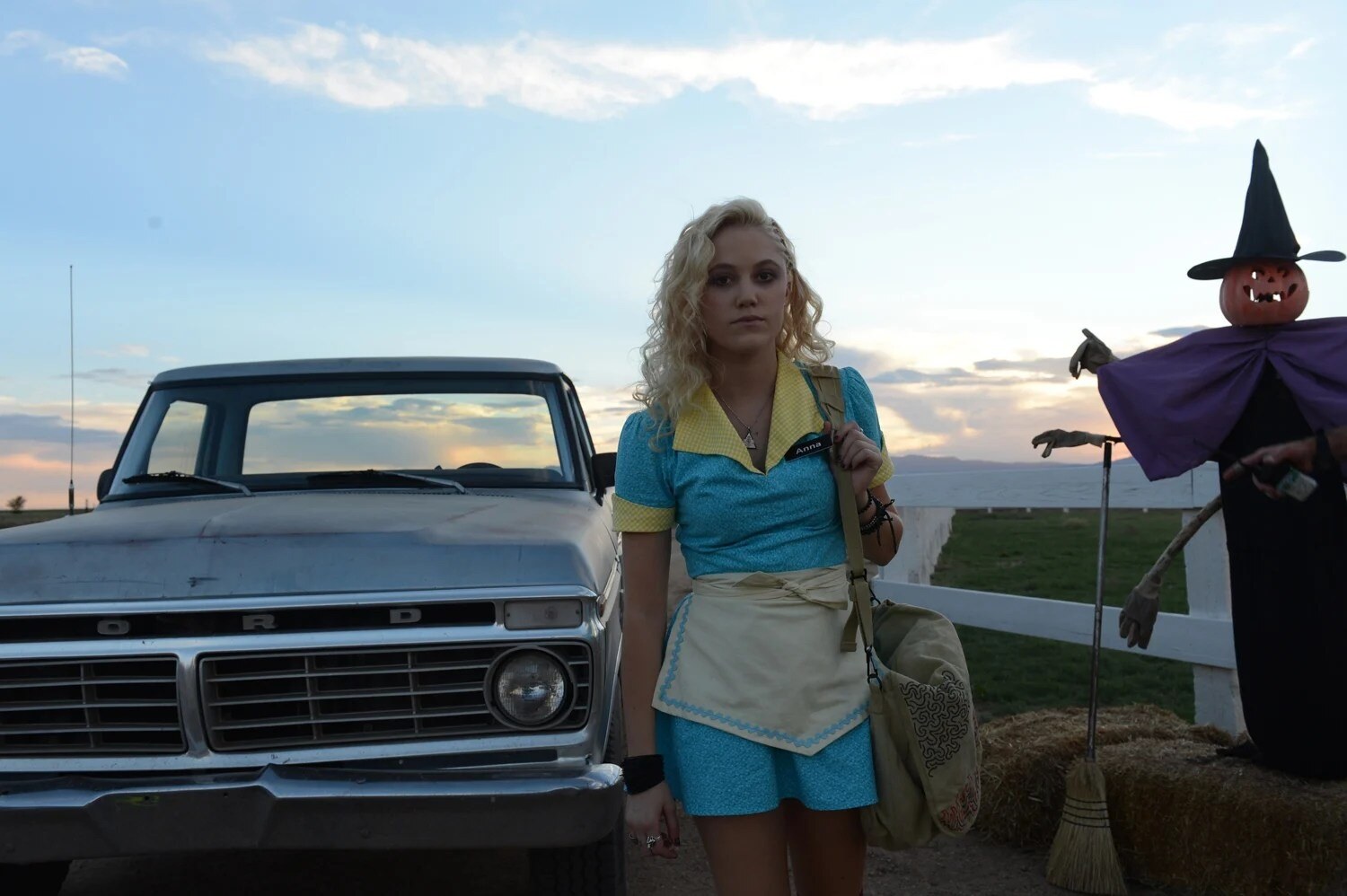
Here is what it does not buy. It does not buy a coherent politics lecture. THR already noted the opening collage of robot soldiers, Abu Ghraib photos, and headlines about Operation Paperclip-style Nazi scientist recruitment, then said the themes never get fleshed out. The theory of a shared military-horror universe is stronger than the movie's essay about that universe. It does not buy Maika Monroe walking back into frame just because Anna Peterson's waitress uniform still looks perfect on a scarecrow lawn. It does not buy a timeline spreadsheet where David's body count in 2014 mathematically predicts Celeste's body count in 2026. Continuity here is municipal and institutional, not chronometer. Fans who need a shared-universe spreadsheet will be disappointed. Fans who need a town that stays cursed will be fed.
I keep thinking about how other desks on this site handle franchise funerals and shared rooms. Doomsday is a funeral with a trailer is Marvel selling grief as scale. The Moriarty trilogy is the opposite bet: small towns, private houses, trailer parks, programs that never make the press conference. Toxic opened like a video-game launch was about shipping a disc-shaped movie. Onslaught is about shipping a town-shaped lore drop two days before the weekend. The Reviews desk grades the craft in arjona-is-the-onslaught-that-holds. Theories desk today is telling you the craft is attached to an address Wingard already spoke aloud.
Rewatch grammar matters for this theory. The Guest still works as a closed Halloween nightmare if you never hear Wingard's Comic-Con sentence. Onslaught still works as a desert siege if you never saw Stevens smile through a suburban living room in 2014. The shared-universe confirmation is optional lore that becomes mandatory homework the moment you care about Barrett and Wingard as a pairing. That is different from MCU homework culture. Nobody is docking you points for skipping a Disney+ show. The docking here is taste. If you show up Friday without The Guest in your ear, you will still understand super soldiers. You will miss why Moriarty feels like a punchline that already landed once.
There is also a production-history tell. Wingard spent the back half of the 2010s and early 2020s inside Legendary's monster aisle. Leaving Godzilla x Kong: Supernova talk behind and landing at A24 with Barrett for a ninety-two-minute R-rated original is itself a theory about what the market will still buy from him. The Guest-universe stamp is how you market a return without calling it a retreat. You are not going smaller. You are going home. Home happens to be a New Mexico pin with a body count. I buy that packaging more than I buy any spreadsheet that tries to date David's experiments against Celeste's facility escape. Institutions linger. Timestamps lie.
So the Wednesday theory, stated clean. Onslaught is not a secret sequel that pretends it is not a sequel. It is an admitted same-universe capstone that reuses Moriarty, reuses Barrett, reuses Stevens in a new mask, and asks you to treat You're Next, The Guest, and this desert siege as one industrial horror argument. The soldiers are other aspects of the program that made David. The town is the same pin. The trilogy language is Wingard's, not mine. Watch The Guest again before Friday if you want the homework. Watch Onslaught on Friday if you want the louder chapter. Do not wait for a mid-credit David smile that the director already told you is not the point. The point is the town that keeps producing American nightmares and calling them training exercises. Moriarty is the SKU. The Guest never left. Onslaught just turned the volume up until the trailer park could hear it.
Original commentary based on public reporting. Not a reprint.