
Korea sent Possible Love to the Oscars before Venice. That is a layoff movie wearing a love title.
Lee Chang-dong spent a decade on two marriages and a mass firing. KOFIC picked the film Tuesday. Netflix paid when Korean theaters could not.

Tuesday morning in Seoul, Lee Chang-dong sat with four actors and tried to explain a title. Later on Tuesday, the Korean Film Council made the title a national export. Possible Love, his first feature in eight years, is South Korea's official submission for Best International Feature at the 99th Academy Awards. The world premiere is still a week away, in the main competition of the 83rd Venice International Film Festival. That sequence is the story. A country picked the movie before the Lido clapped, before Toronto, before anyone with a byline filed a verdict. I have not seen it. You have not seen it. A committee has, and they sent it anyway. Per hollywoodreporter.com.
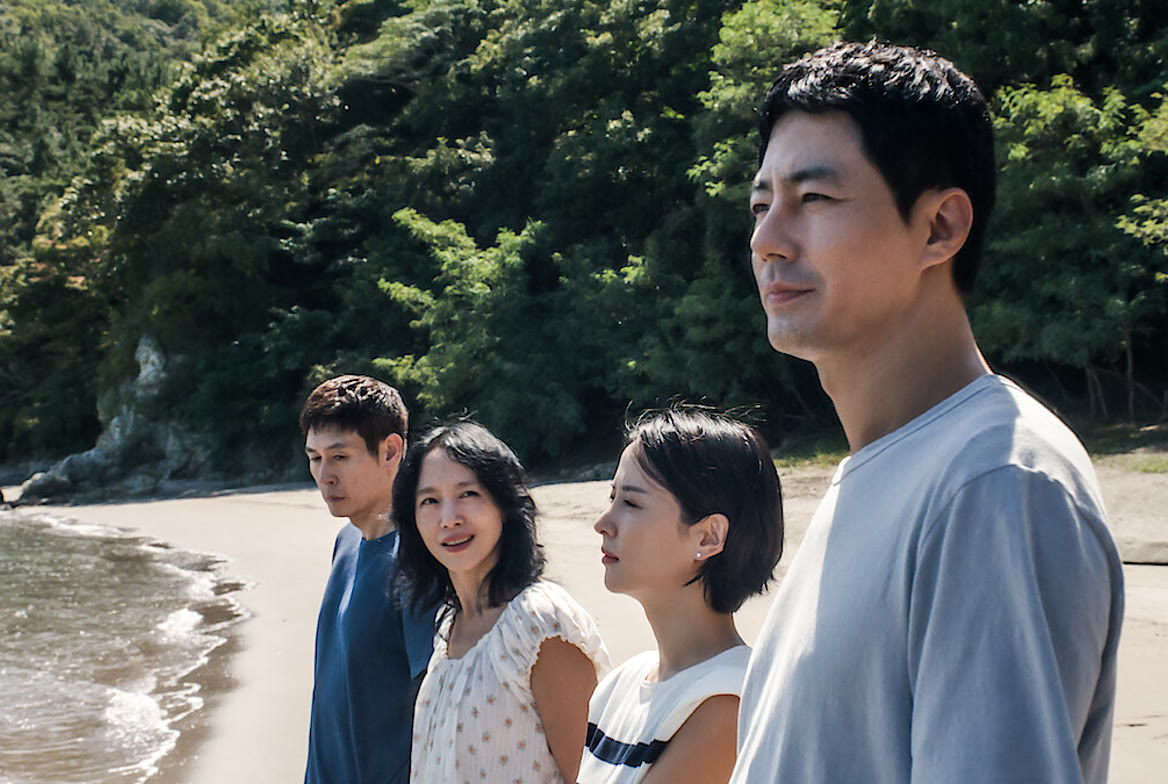
I keep a short list of words countries reach for when they are scared. Love is high on that list. Layoff is higher. Possible Love has both, and the second one is doing the real work. Yonhap, The Korea Times, Variety, and the festival program all describe the same engine: two marriages, a documentary camera, and a man who lost his job. Ho-seok, played by Sul Kyung-gu, is a laid-off worker. His wife, Mi-ok, is Jeon Do-yeon. Ye-ji, a documentary filmmaker played by Cho Yeo-jeong, wants to put their lives on tape. Her husband, Sang-woo, is Zo In-sung, affluent enough that a beachfront villa is available when the shoot needs a location. The Korea Times, writing out of Tuesday's press conference at Hotel Naru Seoul MGallery in Mapo, added the details the one-line synopsis keeps sanding down. Mi-ok works at a mask factory. Ho-seok is carrying trauma from a violent strike crackdown. When Ye-ji invites the other couple to Sang-woo's villa for a joint summer vacation, class stops being a backdrop and starts being a weather system.
That is not a romance with a social issue taped to the poster. That is a social issue that needed a title people would sit with. Lee said the quiet part at the microphone. "As the title suggests, it is a film about love," he told Yonhap. "When we think of love, there is love between a man and a woman as well as different forms of love. It questions what kind of love is possible as we live and what we should do to protect it." The Korea Herald had him sharper still: every love story arrives with an unspoken impossible in front of it, and a love everyone blesses does not need telling. He asked the opposite question. What kind of love is possible, and what does it take to keep it.
Korea did not send a romance. It sent a layoff, then asked the title to do the comforting.
He has been circling this story for about a decade. Yonhap reported that he started with a conglomerate firing and a couple, with Jeon and Sul already in his head as the leads, then stalled because he could not persuade himself the result would be different from the documentaries that already follow those workers around. Last year, Oh Jung-mi, who co-wrote Burning with him, suggested another couple, another class, another camera inside the movie. That rewrite is the film. A worker picture that was afraid of being a pamphlet became a movie about people who film other people for a living. I have watched enough Korean cinema this century to know what that second couple is for. They are not local color. They are the audience, inserted into the frame so the audience cannot pretend it is only watching.
Lee does not want you to play name-the-chaebol. "We are all workers in some way and in that sense a layoff will change everyday lives," he said, per Yonhap. "Since our identities are shaped by what we do for a living, it cannot but change people's identities." Then the line that is going to follow this movie from Venice to March: "When this power becomes bigger, I think what upholds our lives is love. That love is not confined to love between a man and a woman, but I think the essence of a relationship is love. It is a relationship based on love that makes us carry on with our lives." The Korea Times heard a cousin of that thought. He spent more than a decade on a story inspired by a real mass layoff at a major Korean conglomerate. "As the control of capital over our lives grows stronger, I wondered how we should survive," he said. "I believed that what supports our lives during tough times is love between people."
I believe he believes that. I also believe a director who once made Peppermint Candy, Oasis, Secret Sunshine, Poetry, and Burning does not spend ten years on a firing so he can land on a greeting card. Love, in his movies, is the thing that fails in public and keeps going in private. Jeon won Best Actress at Cannes for Secret Sunshine in 2007, a film about grief that refused to become uplifting no matter how hard the plot begged. Sul broke out in Peppermint Candy and Oasis, the latter of which took the Silver Lion for best director at Venice in 2002. This is Lee's first time back on the Lido since that prize. Burning, in 2018, competed for the Palme d'Or, won the FIPRESCI prize, and became the first Korean film to reach the Academy's nine-film foreign-language shortlist. A year later Parasite walked through the door Lee had already cracked. Possible Love is the seventh feature. It runs 164 minutes. That is not a platform snack. That is a director asking for the same patience he has always asked for, on a service that is not famous for patience.
KOFIC's selection committee, in the statement Yonhap carried, praised the film for "cinematic completeness, the clarity of the director's message and its excellent mise-en-scene." Committees talk like that. I do not know if the mise-en-scene is excellent. I know they saw a cut the rest of us have not, and I know the language is the language of a country that has learned how Oscar packets get written. Last year the same body sent Park Chan-wook's No Other Choice, a black comedy about a laid-off paper man who starts killing his competition. That film premiered in Venice, made the international-feature shortlist, and did not get into the final five. Two years, two auteurs, two movies about what a firing does to a man who thought the job was the identity. Park turned the wound into farce and homicide. Lee, if the logline is honest, turned it into a documentary shoot and a villa. Same Korean century. Different temperature.
The cast presser was a reunion with a new wing. Jeon is back with Lee for the first time since Secret Sunshine. She did not dress it up. "The most attractive thing was Director Lee Chang-dong," she said at the hotel, per Maeil Business. She asked for the script the way you ask for a letter you are afraid will not arrive. When she closed it, the afterglow was strong enough that she thought, as expected, Lee Chang-dong. Sul, on his third film with the director, told The Korea Times that Peppermint Candy had been physically and emotionally overwhelming because he lacked experience, and that he had spent the years since longing for those intense days. Getting the wish back, he said, felt like the beginning of his acting career again. Zo, playing a rich man whose flaws are not obvious, said everyone on set felt like a beginner in front of Lee's direction. Cho Yeo-jeong, who a lot of the planet still knows as the wife in Parasite, talked about existing as the character rather than decorating it. Four people, one excuse. They came because of the director. That is either moving or a warning that the movie has to carry four reputations and a national slot on the first public screening.
Venice opens September 2 with Danny Boyle's Ink and runs through September 12. Maggie Gyllenhaal is jury president. Possible Love sits in a competition of 21 films that also includes Hirokazu Kore-eda's Look Back, Martin McDonagh's Wild Horse Nine, Casey Affleck's Company, and, as of Monday, Yuval Abraham and Rachel Szor's documentary NAZA, the late addition that completed the slate. Lee told the Seoul room his heart was full. "This is where the world sees it first," he said, per The Korea Herald. "I'm curious how audiences are going to take it. I really want to know that first reaction." After Venice comes Toronto, September 10 through 20, in Special Presentations, the North American premiere. Then the 64th New York Film Festival, September 25 through October 12, Main Slate, the U.S. premiere. Film at Lincoln Center's program note is already doing the work of a critic without being one: two middle-aged couples, a taciturn 10-year-old, a violently suppressed strike, a filmmaker who wants subjects, and "queries around nonfiction filmmaking ethics." If that sentence is accurate, the movie is not only about love. It is about the ethics of watching someone lose a life and calling it content.
Lee said this may not be a movie you typically watch on Netflix. That is the most honest line in the rollout.
The platform is not a footnote. It is the production history. The Korea Times reported severe funding hurdles in a prolonged slump in the local industry, which is how a director of Lee's stature ended up with Netflix as a partner. He said the quiet part about that, too. "When I decided to work on the film with investment from Netflix, it was a period when the Korean film industry was at one of its weakest moments and there were doubts about its recovery. Still, I thought films have to be made," he told Yonhap. Then: "Perhaps this film is not a movie you would typically watch on Netflix. But I hope it can be an interesting watch and a work that can change our views on the world we live in as well as our lives." Deadline, when the dates landed in July, read the theatrical window as an awards qualification strategy. Korea on September 23. Australia on October 22. The United States, Canada, the United Kingdom, Ireland, and Japan on October 23. Global streaming on November 6. Variety has the same calendar, plus the Venice and Toronto berths. Netflix Tudum timed the running time at 2 hours 46 minutes and put a still of four people on a beach into the world as if a beach were neutral ground. It is not. In this story the beach is where the classes agree to share a weekend.
I am not going to pretend a 164-minute Lee Chang-dong movie about two marriages is going to behave like a Netflix title. Burning did not behave like a Murakami adaptation either, and it was one. It took a short story about a barn and turned it into a class hallucination you could not shake off in the lobby. Possible Love, on the evidence of the director's own mouth, is trying to do the reverse trick. Take a mass firing, which is already a Korean genre, and refuse to let it become only a headline. The risk is obvious. Love can be a solvent. It can dissolve the layoff into mood. The hope, if you have lived with Oasis and Secret Sunshine, is that he will not allow the solvent to win. He will let the camera inside the movie be as compromising as the camera outside it. A documentary filmmaker who needs a subject is never a neutral instrument. Cho Yeo-jeong playing that part, after Parasite, is a piece of casting I do not need a screening to find loud. She has already been the rich wife in the house that ate the poor family. Now she holds the camera.
The Oscar slot is a different instrument. International Feature is a one-film-per-country raffle dressed up as taste. Korea has used it, in the years I have been paying attention, as a statement about which wound is ready for export. Burning was the unease. Parasite was the house. Decision to Leave was the detective who could not leave the case. No Other Choice was the job market as a killing floor. Possible Love is the job market as a marriage. I do not know yet which of those is the braver sentence. I know which one is easier to campaign. A title with love in it photographs better than a title with no other choice. That is not an insult to Lee. It is a fact about packets and voters and the way a streamer talks about a fall slate. If the movie is as unresolved as his others, the title will start to look like a dare. If it is softer than his others, the title will look like the problem.
Tuesday was the day the dare became official. KOFIC did not wait for a standing ovation. They did not wait for a Variety review from the Sala Grande. They looked at a cut, wrote a sentence about mise-en-scene, and put a 72-year-old novelist-director back on the Oscar clock. Lee Chang-dong was born in 1954. He taught, he wrote fiction, he made six features that already constitute a complete argument about late-20th and early-21st century Korea, and he even did a stint as minister of culture. He does not need a nomination to be in the book. He needs an audience that will sit for 164 minutes and not treat the villa as scenery. I will try to see it in a theater in late October, in the brief window before the homepage swallows it. If you care about this director, do the same. The streamer paid for the movie when the local industry could not. That does not mean the streamer is the right room.
Until Venice, all we have is a press conference, a committee, and a plot about people filming other people after a firing. That is already a lot. It is also, inconveniently, the assignment Korean movies keep handing us. Someone loses the job. Someone else has a camera. The question is whether love is what remains when the identity goes, or whether love is the story we tell so we do not have to look at the identity going. Lee asked it out loud on Tuesday. The country put his question on the Oscar form before the rest of us could answer. I will take the question. I will wait for the movie. I will not confuse the title with the proof.
Related reading: Practical Magic 2 dethroned Spider-Man on a soft $30 million weekend.
Related reading: The Odyssey is the highest-grossing R-rated movie ever. That is a camera story, not a translation..
How we made this: researched and drafted with AI assistance. Sources are linked in the piece.
Original commentary based on public reporting. Not a reprint. Editorial standards.