
Which Final Fantasy should you play first in Origins of Light?
Kess's Origins of Light: A Final Fantasy Board Game is live on Kickstarter through November 18, past $500,000 on a $10,000 goal. It plays Final Fantasy I, II and III with different rules, and the easy module is the long one at a full table.

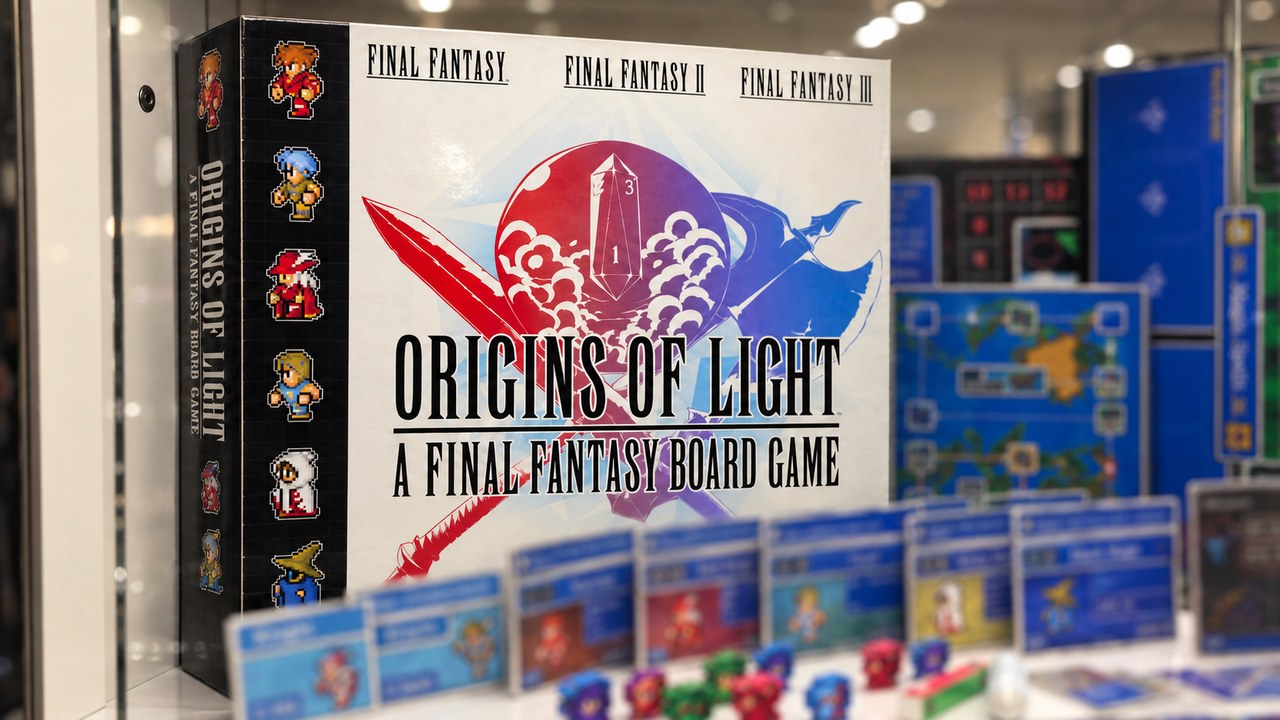
Origins of Light: A Final Fantasy Board Game went live on Kickstarter on Tuesday at 1 PM Eastern, and its $10,000 goal is already a rounding error. Kess's officially licensed game, made with Square Enix, adapts the Pixel Remaster versions of Final Fantasy I, II and III. Xeznaff has the campaign window: October 20 to November 18. As of Wednesday morning, Tabletop Analytics showed $509,996 pledged against a $10,000 goal from 1,771 backers.
That is not the interesting number, though. The same tracker lists the average pledge at $288. More on that in a minute.
Three games, three different rulesets
The pitch is simple. You run a party of four across a board drawn from that game's world map, fight monsters, spend Gil in town on weapons, items and magic, and work toward the final boss. God is a Geek's preview is the clearest on how each module plays, and the important detail is that each one plays by its own rules. Here is the breakdown, with the session math I did from the times the design team gave.
| Module | Party building | Structure | Stated time | At two players / four players (my math) |
|---|---|---|---|---|
| Final Fantasy I | Pick from six jobs (Fighter, Monk, Thief, Black, White, Red Mage) | World map board, simplest to learn | About 60 min per player | About 2 hours / about 4 hours |
| Final Fantasy II | Nine named characters, including Firion, Guy, Leon and Richard | Draw tiles to reveal fights, treasure or bosses (roguelite) | About 90 min total | About 90 min either way |
| Final Fantasy III | Draft from 24 jobs, including Dark Knight, Bard and Geomancer | One fewer boss than II, but drafting adds time | Close to II | Roughly 90 min plus the draft |
| Quick Play | Characters from I and II | Faster roguelite on the back of the II map | Faster | The weeknight option |
Look at that last column. Final Fantasy I is pitched as the entry point, and it is the simplest to learn, but at a full table of four it is the longest session in the box by a wide margin. Final Fantasy II, the one with the strange use-it-to-level system from the Famicom days, is the one that fits a game night. If I were teaching this to a group, I would teach the I rules at two players and play II when all four seats are full.
The "easy" module is the long one. At a full table, Final Fantasy I runs about twice as long as II.
The preview quotes the design team putting the progression neatly: each version increases in complexity, "but not as much difficulty." It also supports a solo ruleset on top of the two to four player game, which matters for a license whose fans spent decades playing these alone.
The $288 question
TechRaptor's preview lays out the pledge ladder in broad strokes. The base tier is a copy of the game at MSRP. Upgrade 1 adds premium components such as metal Gil and lenticular summons. Upgrade 2 adds the Final Fantasy IV expansion, which God is a Geek describes as a two-player variant. Upgrade 3 is everything. There are add-ons too, including premium maps, sleeves and a premium board. Xeznaff adds that Final Fantasy IV can also be bought as an add-on or standalone pledge.
I am not going to quote tier prices here. Kickstarter does not let us load the campaign page cleanly, and I would rather leave the prices off than guess at them. But the average tells the story without them. A $288 average pledge on the first day is not a crowd buying the base box. That is a crowd going straight for metal Gil and the extra game. Final Fantasy fans have always been collectors first, and the early money says this campaign is being funded by people who want the deluxe version on their table, not by curious board gamers trying a license.
Before you back it
- Delivery is a long way off. TechRaptor says the plan is May or June 2027, if everything goes to schedule.
- Check shipping. Xeznaff lists North America, South America, Europe, Australia and New Zealand.
- Decide on Final Fantasy IV early. It is the one piece of content that is not in the base box. If you want it, plan for it during the campaign instead of hoping for a late option.
- Know what the art is. God is a Geek says the characters, monsters, bosses and item icons use official Square Enix sprites. The in-game town is new art by Square Enix's own team.
- Count your group. If your table is usually four, use the time table above. The module you pick changes your evening.
Tuesday was a busy day for video games turning into board games. Clash Royale: The Grand Arena was due on Kickstarter the same day, and the Satisfactory board game opened on Gamefound last week. Origins of Light has the easiest job of the three. Final Fantasy I was already a game about moving a party across a map and fighting turn by turn. It practically was a board game with a screen attached. The question now is whether a crowd spending $288 a head gets a game that hits the table, or just a very nice box.
How we made this: researched and drafted with AI assistance. Sources are linked in the piece.
How we made this: researched and drafted with AI assistance. Sources are linked in the piece.
Original commentary based on public reporting. Not a reprint. Editorial standards.