Dizzy's lost Mega Drive collection is heading to Kickstarter
The Eggcellent Dizzy Collection puts Dizzy the Adventurer, Go! Dizzy Go! and Panic! Dizzy on one Mega Drive cartridge, the Sega release that never shipped in 1994. Here is each game's history and what the Kickstarter still needs to answer.

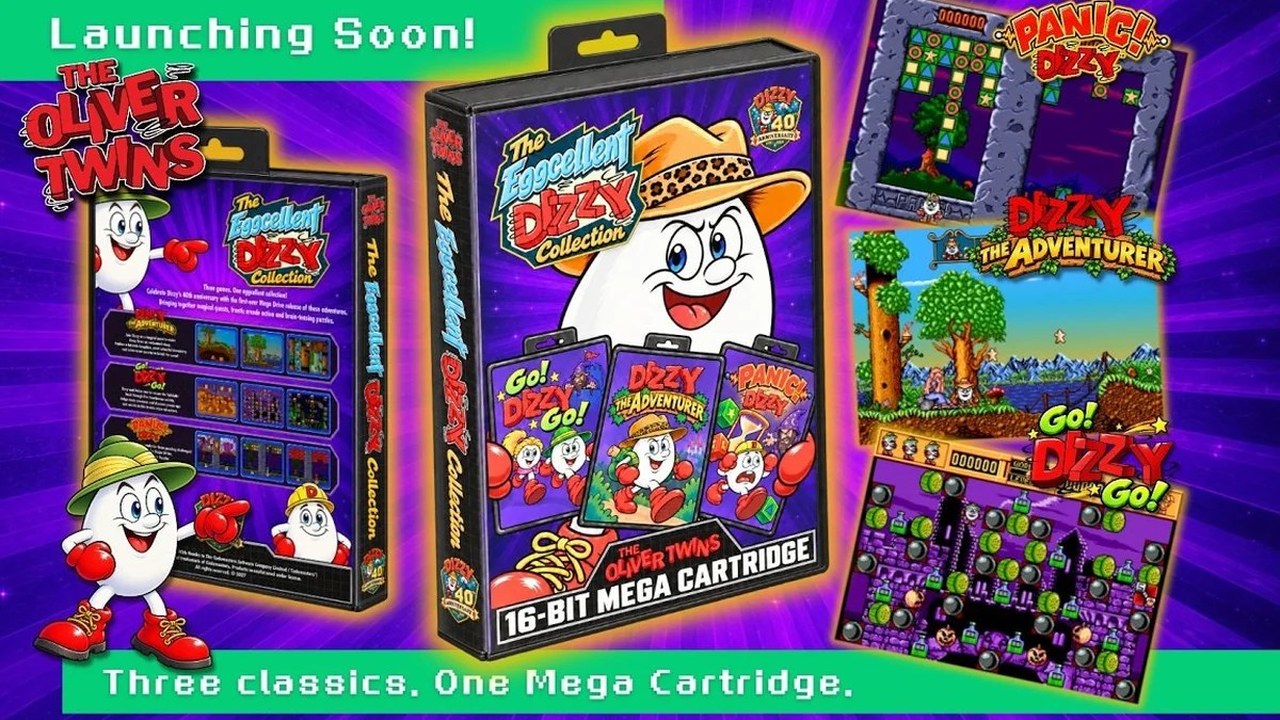
Some games die in a warehouse. Some never make it that far. The Eggcellent Dizzy Collection is a rescue of the second kind. On Saturday at noon, at the Crash Live retro show in Coventry, Philip and Andrew Oliver announced a single Sega Mega Drive compatible cartridge carrying three of their old Dizzy games: Dizzy the Adventurer, Go! Dizzy Go! and Panic! Dizzy. Their press release pitches it as the start of Dizzy's 40th anniversary year, since the egg first appeared from Codemasters in 1987. A teaser on the twins' YouTube channel shows a boxed cartridge labeled "16-bit Mega Cartridge."
What you cannot do yet is buy it. The project is going to Kickstarter, but for now there is only a preview page with a "Notify me on launch" button. Time Extension confirms the campaign is not live, and nobody has announced a price, a ship date, or reward tiers. So this is a "what we know" piece, and the part I care about is older than the announcement.
This cartridge was supposed to exist in 1994
These are not three random picks. They are the same three games that made up The Excellent Dizzy Collection, the Codemasters compilation from the early 1990s, and a Mega Drive version of that compilation never came out. The Oliver Twins say it plainly on their own Go! Dizzy Go! page: the collection was released on Game Gear and Master System in a very small run, and "it was never released on Megadrive."
The story behind that is a small tragedy of dead hardware, which is my favorite kind. Dizzy the Adventurer was the free pack-in game for the Aladdin Deck Enhancer, a Codemasters gadget for the NES that put the expensive chips in one adaptor so later games could sell as cheap plug-in cartridges. Per the twins, the Aladdin failed in the US and its distributor, Camerica, went bust. They then converted the game to Master System, Game Gear and Mega Drive for the Sega collection. Wikipedia's entry traces it back further: Dizzy the Adventurer is an enhanced version of 1991's Dizzy: Prince of the Yolkfolk, re-released with the Aladdin in November 1992.
Panic! Dizzy has the saddest note attached. On the twins' Panic Dizzy page, they explain that they rebuilt the old computer puzzle game from scratch for the NES with five puzzle modes, then kept the best three for the 1993 Sega conversions. Codemasters, by their account, duplicated only 5,000 copies on Master System and Game Gear, and the Mega Drive version did not ship. Philip adds that this was "especially sad, since it was the last game I wrote."
A finished Mega Drive game that sat unreleased for three decades is a better pitch than any 40th anniversary logo.
The three games, and where each one has been
Here is the paper trail in one place, built from the twins' own game pages, the Excellent Dizzy Collection and Dizzy Panic entries on Wikipedia, and Saturday's release.
| Game | Where it started | NES fate | Early 1990s Sega release | Mega Drive before now |
|---|---|---|---|---|
| Dizzy the Adventurer | Dizzy: Prince of the Yolkfolk (1991, home computers) | Aladdin Deck Enhancer pack-in, November 1992 | Part of The Excellent Dizzy Collection | Converted, never released |
| Go! Dizzy Go! | Built for the Aladdin as a maze game across five worlds, with simultaneous two-player | Released on a Codemasters Quattro multi-game NES cart in 1992 | Part of The Excellent Dizzy Collection | Converted, never released |
| Panic! Dizzy | Dizzy Panic (1991, CPC, Spectrum, Commodore 64) | Redesigned with five puzzle modes, unreleased at the time | Kept the best three modes for the collection | Converted, never released; Philip calls it the last game he wrote |
One wrinkle worth knowing before you pay collector prices for anything. The twins' site says the 1993 collection came out on Master System and Game Gear. Wikipedia, citing a February 1994 news page in Mega Power, says the Master System and Mega Drive ports were slated for January 1994 and only the Game Gear version shipped, and only in Europe. The sources disagree on the Master System. They agree completely on the Mega Drive. In 1994, a Mega Drive owner got nothing.
Two more games were meant for that compilation too. Gamebeacon notes, citing the twins' site, that DreamWorld Pogie and Wonderland Dizzy were cut because of cartridge costs. Wonderland Dizzy finally came out in 2015, and Wikipedia says DreamWorld Pogie got an official release in 2017 after a successful Kickstarter.
The crowdfunding baggage
The twins have been here before, and not every time went well. Time Extension points out that their 2017 Dizzy Returns campaign was cancelled after raising £25,620 of a £350,000 goal. That was a brand new adventure, though. This one is three games that already exist in finished form, which is a far smaller and far more believable ask.
The other piece of baggage is newer. Time Extension also notes that the twins have teased a separate new game, Ultra Dizzy, that appears to use generative AI elements, and that they have embraced the tech in other recent projects. Nothing in Saturday's release says AI touched this collection. But the people most likely to back a Mega Drive cartridge of unknown price are the people most likely to care, and I would rather the campaign page answer that question up front than leave it to the comments.
Where it would actually play
The timing is funny. One day before this reveal, Analogue announced the Mega Sg+, a $219.99 FPGA console built to play original Mega Drive and Genesis cartridges, with preorders opening Monday. A brand new physical Dizzy cart is exactly the kind of thing that makes a box like that feel less like a museum piece. It is also the second time in a week that a pile of old ports got a second life, after Toy Story: Retro Roundup pulled the Game Boy versions out of the attic.
What I want the Kickstarter page to answer
- The price. Nobody has said, and new-build 16-bit carts with a box and manual are rarely cheap.
- Genesis compatibility. The release says Mega Drive compatible. Time Extension's headline says Genesis and Mega Drive. US owners need a plain yes or no on region checks, plus whether the games run at full speed on 60Hz consoles.
- Which code is on the cart. Is this the finished 1993 Mega Drive conversion, a touched-up version, or something rebuilt? I want the original, warts and all.
- Whether any new art is AI-made. Given Ultra Dizzy, say it clearly.
- A digital or ROM tier. Plenty of people play on FPGA hardware or flash carts and would back a file without needing the plastic.
- A ship window. The release gives none. A finished game should be able to name one.
- The missing two. Is there room for Wonderland Dizzy or DreamWorld Pogie as a stretch goal, finally finishing the lineup the twins originally wanted?
My take: I am in, with my wallet held at arm's length until the page goes live. The pitch here is not "Dizzy is back." Dizzy has been back a few times. The pitch is that a Mega Drive version of three finished games, one of them the last game Philip Oliver says he wrote, has gone unreleased since 1994, and it might finally end up in a real slot. That is a better story than a new game. Now they have to price it like they know that.
How we made this: researched and drafted with AI assistance. Sources are linked in the piece.
How we made this: researched and drafted with AI assistance. Sources are linked in the piece.
Original commentary based on public reporting. Not a reprint. Editorial standards.